Support our educational content for free when you purchase through links on our site. Learn more
🎹 10 Common Pop Chord Progressions That Work

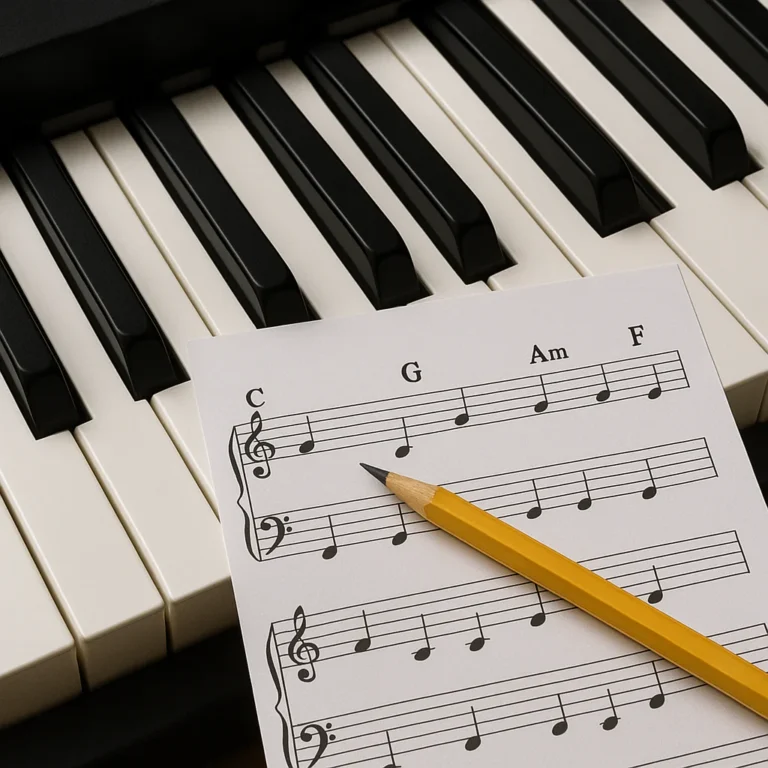
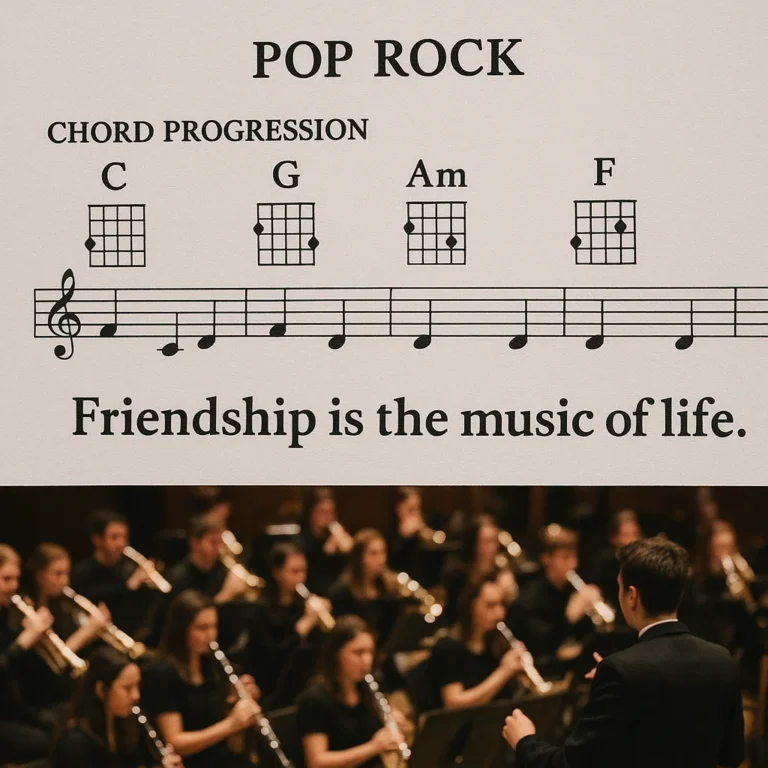
What are the most common chord progressions in modern pop music? One of the best-known is I–V–vi–IV—C–G–Am–F in C major—along with familiar patterns such as I–vi–IV–V and vi–IV–I–V. These progressions offer a strong musical foundation, but melody, rhythm, lyrics, and arrangement are what make a song feel distinctive.
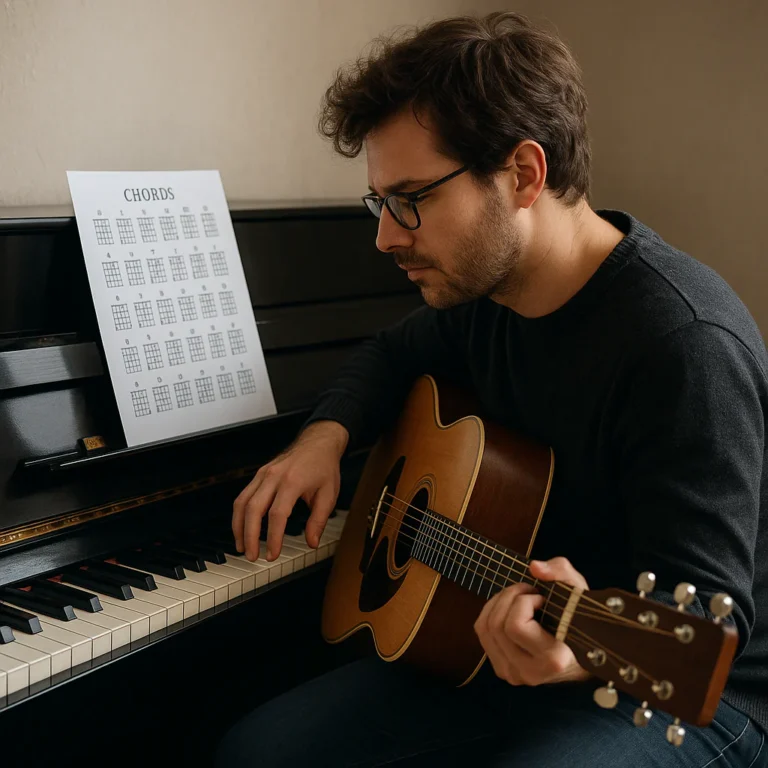
A fun songwriter’s-room experiment: play C–G–Am–F as steady piano chords, then try the same chords with a pulsing synth bass and a syncopated rhythm. The harmony hasn’t changed, but the song’s personality has. That’s the pop-writing secret hiding in plain sight: familiar chords can feel fresh when you change how they move and sound.
Below, we break down 10 widely used pop progressions, explain Roman numerals and chord roles, and show how to play, adapt, and produce your own loops.
Key Takeaways
- I–V–vi–IV is a signature modern pop progression: In C major, play C–G–Am–F.
- Chord order changes the feel: The same chords can sound different when the progression starts on a different chord.
- Roman numerals make patterns portable: I–V–vi–IV in G major becomes G–D–Em–C.
- No progression dictates a mood by itself: Melody, rhythm, tempo, lyrics, and arrangement shape how the harmony feels.
- Use familiar loops as starting points, not formulas: Try new rhythms, inversions, bass lines, voicings, and section changes to make a progression your own.
Table of Contents
- ⚡️ Quick Tips and Facts
- 🎹 Pop Chord Progressions: What They Are and Why They Work
- 📜 A Brief History of Chord Progressions in Modern Pop
- 🎼 Chord Theory Basics: Roman Numerals, Keys, and Diatonic Chords
- Major and Minor Keys at a Glance
- How Roman Numeral Analysis Works
- Chord Inversions, Voicings, and Bass Notes
- 🎤 10 Most Common Chord Progressions in Modern Pop Music
- 1. I–V–vi–IV: C–G–Am–F
- 2. I–vi–IV–V: C–Am–F–G
- 3. I–V–IV–V: C–G–F–G
- 4. vi–IV–I–V: Am–F–C–G
- 5. I–IV–V–IV: C–F–G–F
- 6. I–IV–vi–V: C–F–Am–G
- 7. vi–V–IV–V: Am–G–F–G
- 8. I–♭VII–IV–I: C–B♭–F–C
- 9. i–VII–VI–VII: Am–G–F–G
- 10. i–♭VI–♭III–♭VII: Am–F–C–G
- 🔍 Why These Pop Progressions Sound So Familiar
- Emotional Effects of Major and Minor Chord Sequences
- Tension, Resolution, and Repetition
- How Rhythm and Melody Change the Feel
- 🎸 Pop Chord Progressions by Genre and Mood
- Dance Pop and Synth-Pop
- Indie Pop and Alternative Pop
- Ballads, Acoustic Pop, and Singer-Songwriter Music
- Minor-Key and Dark Pop Progressions
- 🎹 How to Play Common Pop Chord Progressions
- Easy Piano Chord Shapes
- Beginer Guitar Chords and Capo Tips
- Transposing Progressions to a Different Key
- ✍️ Make Your Own Pop Chord Progressions
- Choose a Key and Build a Chord Palette
- Try Different Chord Orders and Loop Lengths
- Add Suspended, Seventh, and Extended Chords
- Use Inversions and Smooth Voice Leading
- Create Contrast Between Verse, Chorus, and Bridge
- 🎧 Producing Pop Chord Progressions in a DAW
- Programming Chords in MIDI
- Choosing Piano, Guitar, Synth, and Pad Sounds
- Build Energy with Rhythm, Dynamics, and Arrangement
- 🚫 Common Chord Progression Mistakes to Avoid
- ✅ Quick Tips for Catchier Pop Harmony
- 🎵 Are Common Chord Progressions Copyrighted?
- 🏁 Conclusion
- 🔗 Recommended Links
- ❓ FAQ
- What is the most common chord progression in pop music?
- Why do so many pop songs use the same four chords?
- Can I write a hit song with a common chord progression?
- What key are most pop songs written in?
- How many chords should a pop progression have?
- How can I make a familiar progression sound original?
- 📚 Reference Links
⚡️ Quick Tips and Facts
- The most recognizable modern pop loop is I–V–vi–IV. In C major, that’s C–G–Am–F. It balances a bright major-key home base with a relative-minor turn, which helps it feel both uplifting and emotional.
- The same four chords can sound dramatically different in a new order. C–G–Am–F and Am–F–C–G share chords, but starting on Am shifts the sense of musical “home.”
- A chord progression is only one part of a song’s identity. Melody, lyrics, rhythm, tempo, vocal delivery, sound choice, and arrangement do plenty of the storytelling.
- Roman numerals describe chord roles rather than fixed chord names. I–V–vi–IV works in many keys; in G major, for example, it becomes G–D–Em–C.
- There is no definitive universal ranking of the most common pop progressions. Lists differ based on which songs, genres, years, and chord-analysis methods they include. Treat these as useful songwriting patterns, not a scientific chart of every pop hit.
- Want the quick version? Start with the most common chord progressions in pop music, then change the rhythm, bass movement, voicing, or melody to make a familiar loop feel like yours.
- Our writer’s-room test: We’ve found it helps to play the same loop three ways—steady block chords, a syncopated rhythm, and a sparse arpeggio—before deciding whether the harmony itself needs changing. Sometimes the “new” progression was hiding in the groove all along. 🎹
| Quick fact | What it means |
|---|---|
| I–V–vi–IV in C | C–G–Am–F |
| vi–IV–I–V in C | Am–F–C–G |
| Major-key I, IV, and V | The first, fourth, and fifth chords built from a major scale |
| Lowercase Roman numerals | Usually indicate minor chords, such as vi |
| Progression length | Many pop loops use two to four chords, but longer sequences and changing sections are common |
| Best starting point | Pick a mood, a key that suits the singer, and a groove—not a rulebook |
🎹 Pop Chord Progressions: What They Are and Why They Work
A chord progression is the order of chords in a piece of music. In pop, those chords often repeat in a loop, giving the melody and lyrics a dependable harmonic backdrop. Think of the progression as the floor beneath a song: it can be simple, but every step across it changes how the tune feels.
The Berklee Online guide to common chord progressions explains that familiar progressions recur because they work well musically—and that writers can personalize them through melody, lyrics, rhythm, and arrangement. That’s a more useful perspective than treating any sequence as a secret formula for a hit.
What makes a progression sound “pop”?
There’s no single chord sequence that makes music pop. Common traits include:
- A clear tonal center: You can usually sense which chord feels like “home.”
- Repetition: A loop creates familiarity and gives listeners something to anticipate.
- A memorable melody: The vocal line often supplies the most distinctive musical material.
- Accessible harmony: Many songs use a compact set of chords, then create interest with rhythm, production, and section changes.
- A strong relationship between harmony and hook: The chords support the tune rather than competing with it.
A progression might loop beneath a verse and chorus, or the song may alter its chord order or harmonic rhythm as sections change. Neither approach is more “pop” by default. What matters is what the song needs.
Why familiar chord loops feel satisfying
Listeners learn a song’s patterns as they hear them. A repeated progression establishes expectations; a melody can then meet, delay, or surprise those expectations. The I chord often feels stable, while the V chord commonly creates a pull toward a point of resolution. The effect depends on context, though: tempo, melody, voicing, and bass line all influence what we hear.
Native Instruments frames progressions as tools for expressing moods across “a wide range,” from happiness to sadness, rather than as fixed emotional labels. That’s a helpful reminder: C–G–Am–F isn’t automatically joyful or sad. A bright tempo and crisp guitar can make it buoyant; a slower pulse, low register, and restrained vocal can turn it reflective. See Native Instruments’ overview of pop chord progressions.
The progression is the recipe’s base, not the finished meal
At Friends Quotes™, we’re used to noticing how one familiar idea can feel fresh when it’s delivered with a different voice. Music works similarly. A four-chord loop can be familiar, while the singer’s phrasing, lyrics, melodic shape, and production make the song personal.
That’s also why chord charts alone can’t explain why one song feels tender and another sounds anthemic. To see how a familiar loop changes with emphasis and arrangement, listen to the featured video as one perspective on widely used progressions.
📜 A Brief History of Chord Progressions in Modern Pop
Modern pop harmony draws on much older traditions. The same major and minor chords have traveled through folk, blues, gospel, jazz, rock, do-wop, dance music, and singer-songwriter styles. Pop has never belonged to one chord recipe; it continually borows and reshapes familiar harmonic moves.
From three-chord songs to four-chord loops
The I–IV–V progression is a long-standing foundation in popular music. In C major, it’s C–F–G. Its chords give a clear sense of home, departure, and return, and its simplicity leaves room for strong melodies and rhythmic variety.
The I–vi–IV–V progression, sometimes called the do-wop or ’50s progression, became closely associated with mid-century popular song. In C, it’s C–Am–F–G. Berklee Online highlights examples ranging from “Earth Angel” to later songs, while also noting that the same sequence appears in different musical settings.
Later pop and rock often favored looping progressions that could support sustained melodies and repeated hooks. I–V–vi–IV—C–G–Am–F in C major—is especially prominent in modern songwriting discussions. The Musicians Institute’s guide to basic chord progressions calls it the “Modern Pop Progression” and describes its emotional-but-uplifting quality.
Why “most common” depends on what you count
A list based on chart hits from one decade may differ from a list based on singer-songwriter songs, dance tracks, or all-time radio favorites. Some analyses count chord changes; others group songs by the underlying harmonic pattern, even when the arrangement or key differs.
So, when sources disagree about which progression is the most common, there may not be a real contradiction. They may be looking at different repertoires or using different criteria. It’s safer to say I–V–vi–IV is one of the best-known and widely used modern pop patterns, rather than claiming it definitively outranks every other progression in every era.
🎼 Chord Theory Basics: Roman Numerals, Keys, and Diatonic Chords
You don’t need advanced theory to use pop progressions. A few ideas make the charts much easier to read—and help you move the same pattern into a key that fits your voice or instrument.
Major and Minor Keys at a Glance
In a major key, each scale note can be the root of a chord built from notes in that scale. For C major, the basic diatonic chords are:
| Scale degree | Roman numeral | Chord in C major | Quality |
|---|---|---|---|
| 1 | I | C | Major |
| 2 | ii | Dm | Minor |
| 3 | iii | Em | Minor |
| 4 | IV | F | Major |
| 5 | V | G | Major |
| 6 | vi | Am | Minor |
| 7 | vii° | B diminished | Diminished |
Roman numerals describe each chord’s position and role in the key. In a major-key chart, uppercase numerals usually indicate major chords, lowercase numerals minor chords, and ° a diminished chord.
A useful point of confusion: C major and A minor share the same notes, but they don’t necessarily feel like the same key. The music’s tonal center—what sounds like “home”—helps establish whether a passage is heard as C major, A minor, or something more ambiguous.
How Roman Numeral Analysis Works
Use the major scale as your map:
- Write down the seven notes of the key.
- Build a basic three-note chord on each scale degree.
- Label each chord with its scale-degree number.
- Use uppercase or lowercase to show chord quality.
- Apply the Roman-numeral pattern in another key.
For example, I–V–vi–IV in C is C–G–Am–F. In G major, the same scale-degree pattern is G–D–Em–C. The Roman numerals stay the same because the chord roles stay the same.
A ♭VII chord means a major chord built on the lowered seventh scale degree. In C, that’s B♭ major, a chord borrowed from outside the standard C-major scale. That little flat sign adds a different color, which is why progressions such as I–♭VII–IV–I can sound broad, open, or rock-influenced.
Chord Inversions, Voicings, and Bass Notes
A chord’s notes can be arranged in different orders without changing its basic chord name. Those arrangements are called voicings. If a chord note other than the root is in the bass, the chord is an inversion.
| Term | What changes? | Why use it? |
|---|---|---|
| Root position | Root is the lowest note | Clear, grounded sound |
| First inversion | Third is the lowest note | Smother bass movement |
| Second inversion | Fifth is the lowest note | A lighter or less settled sound |
| Close voicing | Chord notes are grouped nearby | Compact piano or vocal-friendly texture |
| Open voicing | Chord notes are spread across a wider range | Spacious guitar, piano, or synth sound |
Inversions can make a familiar loop feel more polished. For instance, rather than jumping between widely spaced root-position chords, you can keep some notes close together and move the bass more smoothly. The chords remain recognizable, but the transitions feel less like musical furniture being dragged across the floor.
🎤 10 Most Common Chord Progressions in Modern Pop Music
These ten patterns are practical starting points drawn from common pop, rock, dance, and singer-songwriter harmony. They are not a ranked statistical survey. Different sources and song samples produce different lists, so we’ve included a range of major-key loops, minor-key patterns, and borrowed-chord sounds.
Examples are in C major or A minor for easy comparison. Chord names can vary with key and arrangement; Roman numerals show the reusable pattern.
| Progression | Example in C major or A minor | Common character |
|---|---|---|
| I–V–vi–IV | C–G–Am–F | Broad, emotional, familiar |
| I–vi–IV–V | C–Am–F–G | Nostalgic, melodic |
| I–V–IV–V | C–G–F–G | Driving, anthemic |
| vi–IV–I–V | Am–F–C–G | Reflective, dramatic |
| I–IV–V–IV | C–F–G–F | Direct, open |
| I–IV–vi–V | C–F–Am–G | Bright with a minor turn |
| vi–V–IV–V | Am–G–F–G | Descending, tense |
| I–♭VII–IV–I | C–B♭–F–C | Open, Mixolydian-tinged |
| i–VII–VI–VII | Am–G–F–G | Minor, cyclical |
| i–♭VI–♭III–♭VII | Am–F–C–G | Cinematic, expansive |
1. I–V–vi–IV: C–G–Am–F
This four-chord pattern is one of pop’s best-known harmonic loops. In C major, play C–G–Am–F. It starts with the tonic, moves to the dominant, visits the relative minor, and arrives at the subdominant before the loop begins again.
- Why writers use it: The chords feel familiar, but the Am adds an emotional shade.
- Why it loops well: The final F leads naturally back to C in many arrangements.
- Where it can fit: Pop choruses, acoustic ballads, dance tracks, and singer-songwriter songs.
- How to vary it: Change the bass pattern, use inversions, or hold one chord longer to create a different contour.
The Musicians Institute describes this as a common modern-pop progression, while Berklee Online discusses its widespread use across songs and styles. Those sources support its reputation as a familiar pattern, but that doesn’t mean every song using it will sound alike—or that it always produces the same mood.
2. I–vi–IV–V: C–Am–F–G
Known as the doo-wop or ’50s progression, this sequence offers a memorable route from home through a minor chord and back toward a strong dominant. The G at the end can create a clear pull toward C when the loop restarts.
- Strength: It gives melodies a straightforward, singable harmonic path.
- Possible drawback: Its nostalgic associations may be stronger than you want in a modern track.
- Fresh approach: Use a contemporary beat, unexpected syncopation, or a more spacious keyboard voicing.
Berklee Online notes that this progression has appeared in songs from different eras, illustrating how a familiar sequence can outlive its original style associations.
3. I–V–IV–V: C–G–F–G
This pattern puts the I, IV, and V chords to work in a compact loop. In C, it’s C–G–F–G. The repeated G supplies forward motion and makes the sequence a useful choice for an energetic hook or anthem-style section.
- Try it when: You want a direct, sturdy chord bed.
- Watch for: A predictable loop if the rhythm and melody repeat without variation.
- Add contrast: Change the chord rhythm between verse and chorus, or let a vocal pickup land before the next chord.
4. vi–IV–I–V: Am–F–C–G
The chords are the same as I–V–vi–IV, but the order begins on vi, the relative minor. In C, that gives Am–F–C–G. The sequence can feel more reflective because the opening chord shifts the listener’s attention away from C as the immediate point of arrival.
The Musicians Institute describes this minor-starting version as a fit for emotional pop and related styles. We’d treat that as a useful tendency, not a fixed emotional rule: the melody and production can make the same chord order sound intimate, dramatic, or even bright.
5. I–IV–V–IV: C–F–G–F
This pattern emphasizes the movement among tonic, subdominant, and dominant chords. The second F after G softens the sense of a final arrival, so the loop can feel open and ready to continue.
- For guitar: Try simple downstrokes first, then add a rhythmic accent to the offbeats.
- For piano: Keep the left hand steady and experiment with different right-hand voicings.
- For production: A sustained pad can make the harmony feel expansive; a short, dry sound can make it punchier.
6. I–IV–vi–V: C–F–Am–G
Here the progression begins brightly with C and F, turns toward the minor Am, then uses G to create forward motion. That major-to-minor shift can add a little emotional lift or uncertainty without requiring a complicated chord palette.
Try shifting when each chord changes. One chord per bar is an easy starting point, but two beats per chord or a syncopated change can give the same sequence a very different pulse.
7. vi–V–IV–V: Am–G–F–G
This progression starts in A minor and moves through G and F, creating a descending root line before returning to G. Because G appears twice, it gives the loop a strong recurring point of motion.
- Mood potential: Introspective, restless, or dramatic.
- Arrangement idea: Keep the first pass sparse, then add drums or a wider synth layer on the final G.
- Theory note: The chords shown are all available within the C-major/A-minor collection, but the feeling depends on which chord the melody establishes as home.
8. I–♭VII–IV–I: C–B♭–F–C
This pattern introduces B♭, the lowered seventh-degree major chord in C. That chord is outside the ordinary C-major scale, so it adds a borrowed, Mixolydian-flavored sound. The movement from B♭ to F to C can feel broad and open.
In the featured video’s discussion, this kind of progression is presented as a way to create an expansive sound. That’s one useful listening perspective, not a guarantee: tempo, instrumentation, and melody still decide whether it feels triumphant, relaxed, or rough-edged.
9. i–VII–VI–VII: Am–G–F–G
In A minor, this is Am–G–F–G. It shares the same chord names as progression 7, but the Roman-numeral interpretation clarifies the minor-key frame: i–VII–VI–VII. The recurring G avoids the strong leading-tone pull of an E major chord, so the loop can feel circular rather than firmly resolved.
The featured video describes this type of Aeolian vamp as floatier than an Andalusian cadence. That difference comes partly from the ending chord: an E major chord tends to pull more strongly toward Am than G does. The melody may still make G feel like a stopping point, so listen to the whole arrangement rather than judging the chord chart in isolation.
10. i–♭VI–♭III–♭VII: Am–F–C–G
This minor-key progression uses Am–F–C–G. It is made of familiar chords, but the Roman numerals show how they function when A minor is the tonal center: i–♭VI–♭III–♭VII.
It can support a broad, cinematic sound, especially with sustained chords and a strong melody. The sequence may also be heard as vi–IV–I–V in C major, depending on which chord sounds like home. Chord names alone don’t determine the key.
Two neighboring progressions worth knowing
These patterns aren’t included in the ten-item list, but they’re useful extensions:
- I–IV–V: The classic three-chord foundation. In C, that’s C–F–G. Berklee Online highlights its presence across multiple genres.
- ii–V–I: In C, Dm–G–C. It’s especially familiar in jazz and can add a more deliberate harmonic resolution to pop or neo-soul writing.
- Pachelbel-style sequences: Longer patterns inspired by the bass and harmony associated with Pachelbel’s Canon. Pop songs may use variations; they’re not always identical to the full classical sequence.
🔍 Why These Pop Progressions Sound So Familiar
Familiar harmony gives listeners a framework. Once the pattern is established, the melody can create interest through repetition, variation, or surprise. Yet the same progression can land differently in two songs—and sometimes even in two sections of one song.
Emotional Effects of Major and Minor Chord Sequences
Major chords are often described as bright and minor chords as sad. Those labels can be useful shorthand, but they’re not emotional laws. A major progression can sound wistful with a slow tempo and restrained delivery; a minor progression can sound energetic when the beat is driving.
A better way to think about mood is to consider several elements together:
| Element | Questions to ask |
|---|---|
| Chord quality | Are the chords mainly major, minor, or mixed? |
| Tonal center | Which chord sounds like home? |
| Melody | Does it rise, fall, repeat, or linger on tense notes? |
| Tempo and rhythm | Does the song feel relaxed, urgent, or danceable? |
| Register and timbre | Are the sounds bright, warm, thin, heavy, or airy? |
| Lyrics and performance | Do the words and vocal delivery support or complicate the harmony? |
Native Instruments’ focus on mood is a helpful reminder to select harmony in relation to the feeling you want, while Berklee’s examples show that the same progression can appear in quite different songs. Neither view suggests that a chord loop dictates emotion on its own.
Tension, Resolution, and Repetition
In many major-key songs, the V chord creates a pull toward I. That movement can offer a clear sense of resolution. But loops don’t always resolve in a traditional way. They may keep circling, end a phrase on a chord that feels unfinished, or use a melody that shifts the listener’s sense of stability.
Try listening for these three things:
- Where does the loop begin? The first chord may not be the tonal center.
- Which chord feels most settled? It may be the chord the melody emphasizes.
- Does the sequence return to that chord? If not, the loop may intentionally feel suspended or unresolved.
This is why a chord sequence written as Am–F–C–G can be understood in more than one way. The chord symbols don’t tell the whole story; the bass, melody, and phrase endings help establish how we hear it.
How Rhythm and Melody Change the Feel
A progression can sound fresh without changing any of its chords. Try one adjustment at a time:
- Syncopate the rhythm: Place chord attacks between the main beats.
- Arpeggiate: Play chord notes separately rather than all at once.
- Change the bass: Use inversions or a moving bass note.
- Vary chord duration: Hold one chord longer or change another early.
- Rewrite the melody: Change its contour, rhythm, or point of emphasis.
- Change the arrangement: Bring in or remove drums, pads, guitar, or backing vocals.
- Use dynamics: Build from a quiet verse to a fuller chorus.
The Musicians Institute also recommends techniques such as inversions, added seventh or ninth chords, rhythmic variation, layers, and automation. These are ways to shape a song’s character—not substitutes for a melody or an arrangement with its own identity.
🎸 Pop Chord Progressions by Genre and Mood
Genre labels can help you make a first guess about sound, but no progression belongs exclusively to one genre. The same four chords can be played as a dance-pop loop, an acoustic ballad, or a stripped-back indie track.
| Style or mood | Progressions to try | Arrangement choices |
|---|---|---|
| Dance pop and synth-pop | I–V–vi–IV; vi–IV–I–V | Pulsing bass, sidechain-style movement, bright synth layers |
| Indie and alternative pop | I–vi–IV–V; i–VII–VI–VII | Distinctive guitar voicings, uneven textures, dynamic changes |
| Ballads and acoustic pop | I–V–vi–IV; I–IV–V | Piano or guitar, open voicings, space around the vocal |
| Dark or dramatic pop | vi–IV–I–V; i–♭VI–♭III–♭VII | Lower register, restrained drums, sustained pads |
| Rock-leaning pop | I–♭VII–IV–I; I–IV–V | Strong guitar rhythm, bass movement, firm drum accents |
Dance Pop and Synth-Pop
A looping sequence can work well in dance music because repetition supports a steady groove. I–V–vi–IV is one possible starting point, but sound design and rhythmic arrangement often do more to define the track’s energy than the chord names.
Try holding the chords as sustained synths while the bass and percussion establish motion. Then create contrast by filtering the layers, changing the register, or removing elements before a chorus drop. The harmony can remain constant while the track evolves.
Indie Pop and Alternative Pop
Indie pop often benefits from personality in the details: unusual voicings, a distinctive guitar sound, a sudden break in the groove, or a melody that doesn’t simply follow the chord roots. I–vi–IV–V offers a familiar foundation; an inversion or altered rhythm can make it feel less square.
If you write with a guitar, experiment with open strings and partial chords. On keys, spread the chord notes across octaves or leave out a note when the arrangement already supplies it.
Ballads, Acoustic Pop, and Singer-Songwriter Music
For a ballad, the amount of space between chord changes matters. A slow progression can feel intimate if the harmony changes only once per bar; it can feel more urgent if the chords move twice as fast.
Begin with a simple version of I–V–vi–IV or I–IV–V, then sing the melody before adding extra harmony. If the lyric needs room, the best choice may be a held chord rather than a new chord for every line.
Minor-Key and Dark Pop Progressions
Minor-key progressions can give a song a more introspective starting point, but arrangement determines how heavy or light the result feels. Try Am–F–C–G with a subdued vocal and low synth, then replay it with brighter percussion and a higher melody. Same chords; very different emotional weather.
Borrowed chords such as ♭VII can add color outside a standard major-key palette. Use them when they support the song’s mood, not simply because a theory chart says they sound “edgy.”
🎹 How to Play Common Pop Chord Progressions
Choose a comfortable key and start with a slow tempo. The goal is to make the chord changes steady before adding a groove. If your hands are learning the shapes, recording one clean pass is more useful than racing through every progression at full speed.
Easy Piano Chord Shapes
For C–G–Am–F, the basic triads are:
| Chord | Right-hand notes | Suggested left hand |
|---|---|---|
| C | C–E–G | C |
| G | G–B–D | G |
| Am | A–C–E | A |
| F | F–A–C | F |
A step-by-step practice plan:
- Play each chord as a block with the right hand.
- Hold each chord for four beats while the left hand plays the root.
- Loop the progression slowly without stopping between chords.
- Add a simple rhythm, such as one chord on beat one.
- Try broken chords, playing the notes one at a time.
- Experiment with inversions to make the right hand move less.
- Record a pass and listen for uneven changes.
For more practice, a music-theory reference such as Berklee Online’s guide to common chord progressions can help connect chord patterns to songwriting choices.
Beginner Guitar Chords and Capo Tips
Open chords make many pop progressions approachable. In C major, a basic loop might use C, G, Am, and F. If the F chord is uncomfortable, a simpler Fmaj7 fingering may work as a temporary practice option, depending on the song and arrangement.
Use a capo to shift the pitch while keeping familiar chord shapes, but check the resulting key and vocal range. A capo changes the sounding pitch; it doesn’t automatically make every chord shape fit every singer.
Practice the transitions in pairs:
- C to G
- G to Am
- Am to F
- F back to C
Make the difficult change a little smoother before trying the full loop. A steady, relaxed strum beats a heroic but uneven flurry.
Transposing Progressions to a Different Key
To transpose a progression, keep its Roman numerals and replace each chord with the matching scale-degree chord in the new key.
| Progression | C major | G major | D major |
|---|---|---|---|
| I–V–vi–IV | C–G–Am–F | G–D–Em–C | D–A–Bm–G |
| I–vi–IV–V | C–Am–F–G | G–Em–C–D | D–Bm–G–A |
| vi–IV–I–V | Am–F–C–G | Em–C–G–D | Bm–G–D–A |
For a singer, choose the key that places the melody comfortably in the vocal range. For a guitarist, choose a key that fits the instrument and preferred chord shapes. For a producer, pitch-shifting can help with experimentation, but it’s still worth checking that the final vocal sounds natural.
✍️ Make Your Own Pop Chord Progressions
A familiar progression is a good starting point, not a finished song. The trick is to make choices that suit your lyric, melody, and arrangement. Here’s a practical process we use when the first loop sounds like it could belong to anybody.
Choose a Key and Build a Chord Palette
Start with a key that works for the singer or main instrument. Then pick a small group of chords from that key.
In C major, a starter palette is C, Dm, Em, F, G, and Am. You don’t have to use all six. Choose three or four, play them in different orders, and sing over them. A simple chord palette can make it easier to focus on melody and phrasing.
Try Different Chord Orders and Loop Lengths
Take the same four chords and change their order:
- C–G–Am–F
- Am–F–C–G
- F–C–G–Am
- C–Am–F–G
Then change the loop length. Two chords can feel hypnotic; four can feel more expansive; a longer sequence may suit a verse that needs more harmonic travel. There isn’t a magic number of chords. Choose the length that supports the phrase.
Add Suspended, Seventh, and Extended Chords
When a basic triad feels too plain, test a color tone:
- sus2 or sus4: Adds an open sound without the usual third.
- Seventh chord: Adds another note that can make the harmony feel richer.
- Ninth chord: Creates a more extended color often heard in R&B, pop, and jazz-influenced writing.
Use extensions selectively. If every chord has extra notes, the progression may become crowded—especially when the vocal, bass, and synth parts already occupy the same range.
Use Inversions and Smooth Voice Leading
Keep shared notes in place when possible, and move other notes by small steps. This is called voice leading. It can make chord changes sound connected and intentional.
- Identify notes shared between two neighboring chords.
- Keep those notes in the same register if it suits the arrangement.
- Move the remaining notes by the smallest practical interval.
- Listen to the bass separately; try an inversion if its jumps feel awkward.
The Musicians Institute also recommends inversions as a way to smooth transitions. It’s a small adjustment with a noticeable effect, especially on piano or layered synth chords.
Create Contrast Between Verse, Chorus, and Bridge
A song doesn’t have to use one progression from start to finish. You can create contrast by:
- Starting the verse on a quieter or less resolved chord.
- Switching to a more familiar, open loop in the chorus.
- Changing chord duration rather than changing the chords.
- Using a contrasting chord or bass note in the bridge.
- Stripping back the arrangement before the final chorus.
The important question is not “Does every section have different chords?” It’s “Does each section feel like it has a reason to be there?”
🎧 Producing Pop Chord Progressions in a DAW
A digital audio workstation (DAW) makes it easy to audition progressions, voicings, instruments, and rhythms. It also makes it easy to keep adding layers until the track sounds like a very enthusiastic pile of furniture. Start simple.
Programming Chords in MIDI
- Set the tempo and create a short loop.
- Enter the chord roots in the bass range.
- Add chord tones above them.
- Choose how long each chord lasts.
- Play a melody over the loop before layering more parts.
- Duplicate the loop, then edit one section to create contrast.
A MIDI chord pack or preset can be a useful sketching tool, but understanding the chord roles gives you more control. You’ll be able to transpose the loop, change its emotional center, and make variations instead of simply accepting whatever a preset hands you.
Choosing Piano, Guitar, Synth, and Pad Sounds
The instrument changes the perceived character of the harmony:
- Piano: Clear attacks; useful for hearing chord changes.
- Acoustic guitar: A natural rhythmic pulse and a familiar singer-songwriter sound.
- Electric guitar: Can add bite, sustain, or atmosphere.
- Synth bass: Strong, controlled low end that can define the groove.
- Pads and strings: Long, soft textures that fill space and support sustained vocals.
In a crowded arrangement, try removing sounds before adding more. A chord doesn’t need a piano, two synths, a guitar, and a pad all playing the same notes. Let each layer serve a different range or rhythmic role.
Build Energy with Rhythm, Dynamics, and Arrangement
You can build a section around the same progression by changing what the listener hears:
- Add percussion gradually.
- Increase the register or width of a pad.
- Switch from held chords to a rhythmic pattern.
- Add backing vocals on the chorus.
- Automate filter or volume changes to create movement.
- Leave a short gap before a hook or vocal entrance.
The Musicians Institute’s production advice includes layering instruments and automating elements such as filters and volume. Use those changes to highlight the song’s structure—not as decoration applied everywhere at once.
🚫 Common Chord Progression Mistakes to Avoid
- Assuming a chord progression writes the song for you. It provides a foundation; the melody and lyric still need their own identity.
- Confusing chord names with tonal center. Am–F–C–G can be heard in different ways depending on the melody, bass, and phrase endings.
- Using complexity as a substitute for emotion. Added chords are useful only when they serve the song.
- Changing chords too often. A vocal may need room to land on a sustained note.
- Ignoring the bass. The bass note can change the feel and function of a chord voicing.
- Overloading the arrangement. If every instrument plays every chord, the hook can lose clarity.
- Treating mood descriptions as guarantees. “Happy,” “sad,” and “epic” are starting points for listening, not fixed outcomes.
- Copying a full musical expression rather than learning a pattern. Berklee Online emphasizes making familiar progressions personal through your own musical choices. A progression by itself is only one ingredient; the surrounding melody, rhythm, lyrics, and arrangement matter too.
A common progression is not a problem to solve. The more useful question is what you do with it.
✅ Quick Tips for Catchier Pop Harmony
- Sing before you add layers. If the melody works with one instrument, it has room to grow.
- Try three different rhythms before abandoning a progression.
- Change the starting chord to explore a new tonal center.
- Use inversions to smooth chord transitions and shape the bass line.
- Let one section contrast. A different rhythm or chord duration may be enough.
- Leave space for the hook. Not every beat needs a chord hit.
- Record and compare versions. Our team finds that quick A/B listening catches details we miss while looping a section.
- Check the singer’s range. Transpose the loop if the melody sits awkwardly.
- Use theory as a map, not a fence. If a chord sounds right in the song, investigate what it does rather than rejecting it because it sits outside the key.
For songwriters who like structured creative prompts, our friendship advice and deep friendship quotes collections may spark a lyric idea. Music and words meet most convincingly when neither is simply decorating the other.
🎵 Are Common Chord Progressions Copyrighted?
A short, familiar chord progression is generally treated differently from a complete song, but copyright questions depend on the full musical work and the facts of a particular dispute. A similar chord loop alone doesn’t automatically mean two songs are the same, and this section isn’t legal advice.
The U.S. Copyright Office explains that copyright protects original works of authorship fixed in a tangible form. For practical guidance, read the Office’s material on music copyright and its copyright basics.
To develop a progression responsibly:
- Use the chord pattern as a starting point.
- Write your own melody, lyrics, rhythm, and arrangement.
- Avoid deliberately imitating a recognizable recording or a distinctive musical passage.
- Keep drafts and session files that document your process.
- Ask a qualified music attorney if you have a specific rights concern.
The useful distinction is between a common harmonic pattern and the broader original expression of a particular song. If you’re unsure about a real release, get professional legal advice rather than relying on a chord-chart comparison.