Support our educational content for free when you purchase through links on our site. Learn more
🎹 How to Write a Catchy Pop Song With 12 Chord Progressions

To write a catchy pop song using basic chord progressions, start with a simple loop, then make it memorable with a clear melody, a strong hook, and a lyric that feels personal. A familiar four-chord pattern can give you a sturdy foundation—but the details you add are what make the song yours.
At Friends Quotes™, we know a few well-chosen words can express a whole friendship. Songwriting works much the same way: a simple idea can stick when it’s specific, singable, and repeated at just the right moment. Try C–G–Am–F, hum over the chords, and see which phrase refuses to leave your head.
Key Takeaways
- Start simple: Try a four-chord progression such as I–V–vi–IV or vi–IV–I–V.
- Choose chords to match the song’s mood: Major and minor chords suggest different colors, but melody, lyrics, rhythm, and performance shape the feeling too.
- Make the melody the star: A memorable hook matters more than a complicated chord sequence.
- Personalize familiar progressions: Change the groove, chord order, bass line, voicings, or arrangement to develop your own sound.
- Write in steps: Choose a feeling, loop the chords, hum a melody, shape the sections, and refine what works.
- Keep the lyric specific: A vivid moment or phrase can make a simple pop song feel unmistakably yours.
Table of Contents
- ⚡️ Quick Tips and Facts
- 🎹 How Basic Chord Progressions Shape Pop Songs
- What Is a Chord Progression?
- Why Simple Chords Can Sound So Catchy
- 📚 A Brief History of Chord Progressions in Pop Music
- 🎼 Major vs. Minor Chord Progressions: Choosing a Mood
- How Major Chords Create an Uplifting Feel
- How Minor Chords Add Emotion and Tension
- 🎤 12 Catchy Pop Chord Progressions to Try
- 1. I–V–vi–IV: The Modern Pop Favorite
- 2. vi–IV–I–V: The Emotional Pop Loop
- 3. I–vi–IV–V: The Classic Do-Wop Progression
- 4. I–IV–V: The Three-Chord Songwriting Staple
- 5. I–V–IV: A Simple, Punchy Pop Pattern
- 6. vi–V–IV–V: Building a Bitersweet Hook
- 7. I–IV–vi–V: A Bright Progression With a Twist
- 8. ii–V–I: Adding a Smooth, Sophisticated Turn
- 9. I–iii–IV–V: Creating a Gentle Lift
- 10. vi–ii–V–I: A Melodic Route Back Home
- 11. i–VI–III–VII: A Cinematic Minor-Key Pop Loop
- 12. I–♭VII–IV: A Bold, Rock-Inflected Pop Progression
- 🔢 Roman Numerals and Chord Numbers, Made Simple
- How to Find the Chords in Any Key
- How to Transpose a Progression
- 🎸 Build a Pop Chord Progression on Piano or Guitar
- Easy Piano Chords and Voicings
- Beginer-Friendly Guitar Chords and Capo Tips
- ✍️ How to Write a Catchy Pop Song Step by Step
- Start With a Hook, Mood, or Lyric Idea
- Choose a Key and Chord Loop
- Create a Memorable Melody Over the Chords
- Shape Verse, Pre-Chorus, Chorus, and Bridge
- 🔁 Is the Same Chord Progression Used in Too Many Songs?
- Why Familiar Chord Lops Still Work
- How to Make a Common Progression Sound Original
- 🎛️ Make Basic Chords Sound Fresh
- Change the Rhythm, Tempo, and Groove
- Use Chord Inversions, Sus Chords, and Add-Ons
- Try a Bass-Line Change or a Different Chord Order
- Layer Instruments and Production Textures
- 🚫 Common Pop Songwriting Mistakes to Avoid
- ✅ Quick Tips for Writing Catchier Chord Progressions
- 🔎 Recommended Links
- ❓ FAQ
- What is the easiest chord progression for a pop song?
- How many chords should a pop song use?
- Can I write a hit song with only four chords?
- Should the verse and chorus use the same progression?
- How do I write a catchy melody over basic chords?
- How can I make a chord progression sound less generic?
- 📖 Reference Links
Table of Contents
- ⚡️ Quick Tips and Facts
- 🎹 How Basic Chord Progressions Shape Pop Songs
- What Is a Chord Progression?
- Why Simple Chords Can Sound So Catchy
- 📚 A Brief History of Chord Progressions in Pop Music
- 🎼 Major vs. Minor Chord Progressions: Choosing a Mood
- How Major Chords Create an Uplifting Feel
- How Minor Chords Add Emotion and Tension
- 🎤 12 Catchy Pop Chord Progressions to Try
- 1. I–V–vi–IV: The Modern Pop Favorite
- 2. vi–IV–I–V: The Emotional Pop Loop
- 3. I–vi–IV–V: The Classic Do-Wop Progression
- 4. I–IV–V: The Three-Chord Songwriting Staple
- 5. I–V–IV: A Simple, Punchy Pop Pattern
- 6. vi–V–IV–V: Building a Bitersweet Hook
- 7. I–IV–vi–V: A Bright Progression With a Twist
- 8. ii–V–I: Adding a Smooth, Sophisticated Turn
- 9. I–iii–IV–V: Creating a Gentle Lift
- 10. vi–ii–V–I: A Melodic Route Back Home
- 11. i–VI–III–VII: A Cinematic Minor-Key Pop Loop
- 12. I–♭VII–IV: A Bold, Rock-Inflected Pop Progression
- 🔢 Roman Numerals and Chord Numbers, Made Simple
- How to Find the Chords in Any Key
- How to Transpose a Progression
- 🎸 Build a Pop Chord Progression on Piano or Guitar
- Easy Piano Chords and Voicings
- Beginer-Friendly Guitar Chords and Capo Tips
- ✍️ How to Write a Catchy Pop Song Step by Step
- Start With a Hook, Mood, or Lyric Idea
- Choose a Key and Chord Loop
- Create a Memorable Melody Over the Chords
- Shape Verse, Pre-Chorus, Chorus, and Bridge
- 🔁 Are the Same Chord Progressions Used in Too Many Songs?
- Why Familiar Chord Lops Still Work
- How to Make a Common Progression Sound Original
- 🎛️ Make Basic Chords Sound Fresh
- Change the Rhythm, Tempo, and Groove
- Use Chord Inversions, Sus Chords, and Add-Ons
- Try a Bass-Line Change or a Different Chord Order
- Layer Instruments and Production Textures
- 🚫 Common Pop Songwriting Mistakes to Avoid
- ✅ Quick Tips for Writing Catchier Chord Progressions
- Conclusion
- 🔎 Recommended Links
- ❓ FAQ
- How can simple chord progressions make a pop song more memorable?
- What are the best chord progressions for writing a catchy pop song?
- How do I write pop lyrics about friendship that are easy to remember?
- Can a simple friendship quote inspire a catchy pop song?
- 📖 Reference Links
⚡️ Quick Tips and Facts
Want a pop song that sticks after one listen? Start with a simple chord loop, then make the melody, lyric, rhythm, and arrangement unmistakably yours. Our Friends Quotes™ writers spend plenty of time finding the right words for friendship; songwriting has a similar trick: a familiar foundation gives a memorable idea somewhere to land.
If you’re looking for more examples of familiar patterns, our guide to the most common chord progressions in pop music is a useful companion.
| Quick fact | What it means for your song |
|---|---|
| A progression is a sequence of chords. | It creates the harmonic setting for your melody and lyrics. |
| Roman numerals show a chord’s role in a key. | I–V–vi–IV describes a pattern you can play in any major key. |
| Repetition helps listeners recognize a hook. | Repeat the loop, but vary the vocal, rhythm, or arrangement to keep it moving. |
| Major and minor are mood clues, not mood laws. | The melody, tempo, lyrics, and performance also shape how a song feels. |
| You don’t need a complicated progression. | A strong lyric and singable melody can make basic chords feel fresh. |
Your five-minute starting plan
- Pick a feeling: hopeful, wistful, celebratory, or bittersweet.
- Choose a key and try four chords: for example, C–G–Am–F in C major.
- Loop the chords at a comfortable tempo on piano, guitar, or a music app.
- Hum before you write: record any phrase that feels natural to sing.
- Change one ingredient at a time: try a new rhythm, melody, bass note, or chord order.
✅ Keep: a progression that makes your melody easier to sing.
❌ Skip: changing chords every few seconds just to make the song sound “advanced.”
We’ll unpack why the familiar four-chord loop works—and how to stop yours from sounding like everybody else’s.
🎹 How Basic Chord Progressions Shape Pop Songs
What Is a Chord Progression?
A chord is a group of notes played together; a chord progression is a sequence of those chords. Think of the chords as the floorplan of a song: they give a melody somewhere to travel, while the singer supplies the color, character, and occasional dramatic furniture.
For example, in C major:
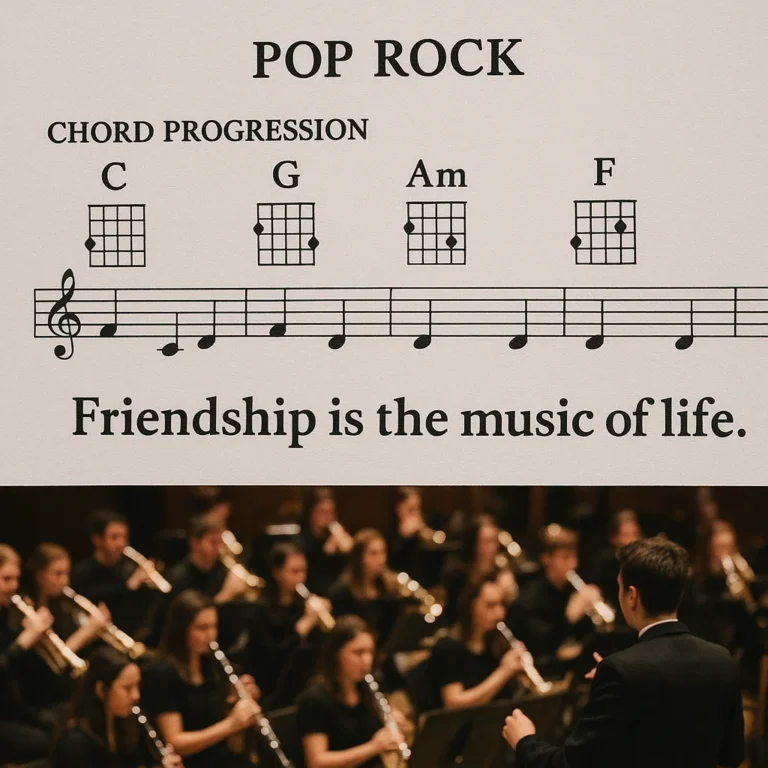
C–G–Am–F
I–V–vi–IV
Those letter names identify the actual chords; the Roman numerals show their relationship to the key. That means the same pattern can be moved to another key without changing its basic harmonic recipe.
The Open Music Theory guide to triads explains the building blocks behind basic major and minor chords. You don’t have to memorize every theory term before writing, though. Start by listening to how the chords support the lyric.
Why Simple Chords Can Sound So Catchy
A simple progression gives the ear a stable pattern to recognize. That leaves room for the parts listeners often remember most: the hook, the vocal rhythm, the lyric, and the production.
The Native Instruments overview of pop chord progressions similarly emphasizes choosing chords that fit a song’s mood and building a melody and other parts around them. Music theory explains the framework; the finished song depends on what you do with it.
Here’s our practical test: loop a progression and sing a phrase over it. If the phrase feels clear and natural, the harmony is doing its job. If you find yourself wrestling with every note, try a different chord order or simplify the melody before adding more theory.
📚 A Brief History of Chord Progressions in Pop Music

Pop music has always borrowed, adapted, and refreshed familiar harmonic patterns. Three-chord songs, do-wop cycles, rock changes, and modern four-chord loops all show how a small set of chords can support a wide range of styles.
The point isn’t that every hit uses one identical formula. It’s that familiar relationships between chords are easy to recognize, and songwriters can create contrast through melody, rhythm, lyrics, vocal delivery, and arrangement. A pattern that feels classic in one song can feel new in another when its hook or groove takes a different path.
A Berklee Online article on songwriting offers a useful broader perspective: craft includes melody, harmony, rhythm, and lyric writing, not harmony alone. In other words, a chord loop is a starting line, not the whole race.
🎼 Major vs. Minor Chord Progressions: Choosing a Mood
Major and minor chords often suggest different emotional colors, but they don’t dictate what a song must feel like. A bright major progression can carry a sad lyric; a minor-key song can feel energetic or defiant. Context matters.
| Starting point | Common first impression | Can also feel… |
|---|---|---|
| Major-key progression | Bright, open, settled | Nostalgic, tense, or bittersweet |
| Minor-key progression | Reflective, dramatic, mody | Confident, driving, or uplifting |
| Major and minor chords mixed | Colorful, familiar, emotionally varied | Simple and direct, depending on melody |
Native Instruments describes major progressions as often bright and minor ones as often darker, while stressing that writers should choose chords to fit their song’s mood. That’s a good rule of thumb—not a law of nature.
How Major Chords Create an Uplifting Feel
A major-key progression gives you a major tonic chord as its home base. In C major, that’s C. A loop such as C–F–G–C can feel sturdy and open, especially when the melody emphasizes notes from those chords.
Try this if you want a chorus to feel like a decision, a reunion, or a window thrown open. For more emotional nuance, keep the major progression but use a wistful melody or reflective lyric. Harmony and words can gently disagree in a compelling way.
How Minor Chords Add Emotion and Tension
A minor-key progression can create a more shadowed or introspective starting point. In A minor, Am–F–C–G gives you a minor tonic followed by chords that can make the loop feel broad and cinematic.
But minor doesn’t automatically mean sad. A fast beat, clipped guitar, and punchy vocal can turn the same harmonic color into something bold. When choosing a progression, ask what the whole track should feel like, not simply whether the first chord is major or minor.
🎤 12 Catchy Pop Chord Progressions to Try
The examples below use C major or A minor where practical. They are songwriting starting points, not guaranteed hit recipes. Play each chord for one bar at first, then experiment with the rhythm.
| Progression | Example in C major or A minor | Starting feel | Good place to try it |
|---|---|---|---|
| I–V–vi–IV | C–G–Am–F | Familiar, open | Chorus |
| vi–IV–I–V | Am–F–C–G | Reflective, expansive | Verse or chorus |
| I–vi–IV–V | C–Am–F–G | Classic, warm | Verse or bridge |
| I–IV–V | C–F–G | Direct, anthemic | Hook or refrain |
| I–V–IV | C–G–F | Punchy, uncomplicated | Rock-pop section |
| vi–V–IV–V | Am–G–F–G | Bitersweet, forward-moving | Pre-chorus |
| I–IV–vi–V | C–F–Am–G | Bright with a turn | Chorus |
| ii–V–I | Dm–G–C | Smooth, resolved | Turnaround |
| I–iii–IV–V | C–Em–F–G | Gentle lift | Verse into chorus |
| vi–ii–V–I | Am–Dm–G–C | Traveling, resolved | Bridge or outro |
| i–VI–III–VII | Am–F–C–G | Cinematic, dramatic | Minor-key loop |
| I–♭VII–IV | C–B♭–F | Bold, rock-inflected | Anthem-style hook |
1. I–V–vi–IV: The Modern Pop Favorite
In C major: C–G–Am–F.
This progression moves from the tonic to the fifth, then to the relative minor and fourth. It gives you a reassuring sense of return while still adding a reflective turn through Am.
Try it with a steady beat first. Then write a melody that uses a small number of notes and repeats a memorable phrase. The Music Theory for Guitar overview of pop songwriting highlights this progression and notes that familiar chords can support very different songs because melody, rhythm, lyrics, and arrangement make each one individual.
2. vi–IV–I–V: The Emotional Pop Loop
In C major: Am–F–C–G.
This is the same group of chords as the previous example, but it begins on Am. Changing the starting point shifts the center of gravity: instead of opening on the major tonic, you begin with a minor chord.
That small change can make the loop feel more searching or reflective. Try placing this progression under a verse, then move to C–G–Am–F for the chorus. The shared chords create continuity; the new starting point helps the section feel different.
3. I–vi–IV–V: The Classic Do-Wop Progression
In C major: C–Am–F–G.
This familiar pattern pairs a grounded major chord with a minor turn before moving through F and G. Its clear chord movement makes it easy to sing over, and its steady feel can work well for a nostalgic, warm, or singalong mood.
For a simple writing exercise, make the lyric rhythm more interesting than the accompaniment. A plain strum under a playful vocal can sound more alive than a busy arrangement that competes with the words.
4. I–IV–V: The Three-Chord Songwriting Staple
In C major: C–F–G.
Three chords are enough to create a strong harmonic frame. The I chord feels like home, IV opens the sound, and V often builds a sense of expectation that can lead back to I.
Hexachords also discusses I–IV–V as a common pop foundation in its article on writing a hit pop song with chord progressions. The advantage is clarity; the challenge is that the melody, groove, and lyric need to provide much of the variation.
5. I–V–IV: A Simple, Punchy Pop Pattern
In C major: C–G–F.
This rearrangement puts the fifth chord before the fourth. Try it with a strong backbeat and short, direct vocal phrases. It can suit a pop-rock sound or a chorus built around a repeated line.
If it feels too predictable, keep the same chords but change the bass pattern or pause briefly before the final chord. A little space can make a familiar loop feel more intentional.
6. vi–V–IV–V: Building a Bitersweet Hook
In C major: Am–G–F–G.
Here, the progression begins on the relative minor and moves downward through G to F before rising back to G. That motion gives you a useful push toward the next section.
It can work well beneath a pre-chorus that gradually builds. Let the melody climb, add a new layer on the last G, or leave a beat of space before the chorus arrives.
7. I–IV–vi–V: A Bright Progression With a Twist
In C major: C–F–Am–G.
C and F establish a bright opening; Am adds a more reflective shade before G points onward. The shift between major and minor colors gives you a little more emotional movement without making the chords hard to play.
Try using longer chord holds in the verse and a more rhythmic strum in the chorus. The progression stays the same, but the energy changes.
8. ii–V–I: Adding a Smooth, Sophisticated Turn
In C major: Dm–G–C.
This three-chord movement is common in many styles, including jazz, and it gives a strong sense of arrival on C. It can be a useful turnaround between sections or a way to make a simple pop progression feel smoother.
If you’re new to the sound, play one chord per bar and listen for how G seems to lean toward C. Keep the melody simple so the chord movement remains clear.
9. I–iii–IV–V: Creating a Gentle Lift
In C major: C–Em–F–G.
The iii chord, Em, gives you a softer color than a more obvious major chord might. It helps the progression move from the home chord toward F and G without a dramatic jump.
This can be effective in a verse that needs to feel calm before a bigger chorus. Use a restrained arrangement at first, then bring in fuller drums or backing vocals when the chorus lands.
10. vi–ii–V–I: A Melodic Route Back Home
In C major: Am–Dm–G–C.
This progression starts with the relative minor, passes through Dm and G, and resolves to C. It’s a longer route back to the tonic than a simple I–V loop, which can create a satisfying feeling of arrival.
Use it when the song needs a bridge or outro that feels like it has traveled somewhere. If four chords feel too busy, hold each one for two bars.
11. i–VI–III–VII: A Cinematic Minor-Key Pop Loop
In A minor: Am–F–C–G.
This minor-key pattern uses the chords Am, F, C, and G. In a major-key context, the same chord family can be heard as vi–IV–I–V; the tonal center and melody help determine whether it feels more like A minor or C major.
For a more distinctly minor sound, emphasize A in the melody and bass, and let the arrangement reinforce that sense of home. This is a good reminder that the same chords can suggest different centers depending on how the song frames them.
12. I–♭VII–IV: A Bold, Rock-Inflected Pop Progression
In C major: C–B♭–F.
The B♭ chord is outside the standard diatonic chords of C major, giving the progression a more rock-oriented color. It can sound broad and bold, particularly with power chords or a strong bass line.
Because it introduces a chord from outside the key, try it by ear first. If the B♭ feels like the right dramatic color, keep it; if it distracts from the hook, return to a simpler in-key option.
🔢 Roman Numerals and Chord Numbers, Made Simple
Roman numerals describe each chord’s position in a scale. Uppercase usually represents a major chord; lowercase represents a minor chord. The chord qualities in a major key follow a useful pattern: major, minor, minor, major, major, minor, diminished.
| Scale degree | Roman numeral | Chord quality in a major key | In C major |
|---|---|---|---|
| 1 | I | Major | C |
| 2 | ii | Minor | Dm |
| 3 | iii | Minor | Em |
| 4 | IV | Major | F |
| 5 | V | Major | G |
| 6 | vi | Minor | Am |
| 7 | vii° | Diminished | B° |
The Open Music Theory materials on diatonic triads explain how these chords are built from notes in a key.
How to Find the Chords in Any Key
To make a progression in a new key:
- Write the notes of the major scale.
- Build a basic chord on each note using scale notes stacked in thirds.
- Match each scale degree to its Roman numeral.
- Replace the numerals in your progression with the chords in that key.
For instance, I–V–vi–IV in C major is C–G–Am–F. In G major, the same pattern becomes G–D–Em–C.
You can use a keyboard, guitar fretboard, a trusted chord reference, or a DAW’s piano roll to check your work. Theory is a map; your ears still get the final vote.
How to Transpose a Progression
Transposing means moving a song’s notes and chords to another key while preserving their relationships. It’s handy when the original key feels too high or low for your vocal range.
Try this:
- Write the progression as Roman numerals first.
- Choose a new key.
- Substitute the chords belonging to that key.
- Sing the melody slowly and check that it sits comfortably.
- If you play guitar, a capo can help you use familiar shapes while raising the sounding pitch.
A piano keyboard diagram from Berklee can help you visualize notes, while a chromatic tuner or instrument app can confirm pitches.
🎸 Build a Pop Chord Progression on Piano or Guitar
You don’t need a full band to write a song. A piano or acoustic guitar is enough to test a progression, find a vocal melody, and record a first draft. The best instrument is usually the one you’ll actually pick up.
| Tool | Strength | Drawback | Good for |
|---|---|---|---|
| Piano or keyboard | Clear visual layout; easy to play several notes at once | Some players find chord shapes unfamiliar | Songwriting, melody testing |
| Acoustic guitar | Portable and naturally rhythmic | Some chord shapes can be tough for beginners | Strumming, lyric writing |
| DAW or music app | Easy to loop, record, and rearrange | Can encourage endless tweaking | Demos and production |
| Voice memo recorder | Fast and low-pressure | Limited editing and sound quality | Capturing melodies before they vanish |
Easy Piano Chords and Voicings
Start with triads: three-note chords built from the root, third, and fifth. In C major, play C–E–G for C, G–B–D for G, A–C–E for Am, and F–A–C for F.
To make changes smoother, use inversions—different arrangements of the same chord notes. Instead of jumping across the keyboard between every chord, keep common notes close together. That’s called voice leading, and it often makes a simple progression sound polished.
For example, try keeping the notes near middle C rather than moving each chord to a new octave. Sing over the loop before adding complicated left-hand patterns.
Beginner-Friendly Guitar Chords and Capo Tips
On guitar, C–G–Am–F is a popular progression, but full F can be difficult for a beginner. You can try a simplified F shape or choose an easier key while you build strength and clean chord changes.
A capo raises the pitch while letting you keep familiar chord shapes. It’s a practical tool, not a shortcut around learning: check that the resulting key suits the singer, and tune the guitar after placing the capo.
For learning chord shapes and basic technique, use the official lesson resources at Fender Play or explore Yamaha’s guitar resources. Take breaks if your fretting hand gets sore; clean, relaxed playing beats tense speed.
✍️ How to Write a Catchy Pop Song Step by Step
A memorable song rarely appears because someone found a magic chord. It usually takes a small idea, a repeatable phrase, and a little editing. Here’s a workflow that keeps the process moving without burying you in options.
Start With a Hook, Mood, or Lyric Idea
Write one sentence that captures the song’s emotional center. It might be a promise, a question, a regret, or a moment between friends. Then reduce it to a short phrase that could become the title or chorus hook.
Try a quick “message to a friend” exercise:
- What would you say if you had one honest sentence?
- Which word carries the emotion?
- Can you say the idea in fewer words?
- Does the phrase sound natural out loud?
Our writers use Friendship Quotes and Deep Friendship Quotes to explore concise ways of expressing connection. A quote isn’t a ready-made lyric, but it can spark a song idea. Rework the thought in your own voice rather than copying a line.
Choose a Key and Chord Loop
Pick an instrument and start with a progression that supports the emotion. If you’re unsure, try I–V–vi–IV for a wide, familiar pop feel or vi–IV–I–V for a more reflective opening.
Then record a simple loop. Don’t judge the first version by how finished it sounds. Ask:
- Does the chord movement leave room for a vocal?
- Does the progression match the lyric’s mood?
- Is there a natural place for the chorus to open up?
- Can you remember the loop after a short break?
At a useful point in this process, the first YouTube video embedded above, “How To Write Chord Progressions – Songwriting Basics” by Signals Music Studio, can help explain how chord movement works. The accompanying Signals Music Studio lesson offers another way to follow the idea in written form.
Create a Memorable Melody Over the Chords
A melody doesn’t need a huge range or vocal acrobatics to be catchy. Begin by humming freely over the loop, then save the phrases you can remember without replaying the recording.
A practical method:
- Speak the hook in rhythm before singing it.
- Sing it one note to find a natural rhythmic shape.
- Add a few pitches and repeat the strongest phrase.
- Leave space after important words.
- Test the melody away from the instrument to see if it stands on its own.
The Berklee Online songwriting resources discuss melody and songwriting craft in a broader musical context. For a practical listening test, record the phrase on your phone and come back to it later. If the hook still feels memorable, you may have found something worth developing.
Shape Verse, Pre-Chorus, Chorus, and Bridge
Song sections create a journey. A verse can establish the scene; a pre-chorus can build anticipation; a chorus can deliver the main idea; and a bridge can offer a fresh angle.
| Section | Main job | Arrangement idea |
|---|---|---|
| Verse | Give details and move the story forward | Keep the texture restrained |
| Pre-chorus | Build tension or momentum | Raise the melody, add percussion, or lengthen the phrases |
| Chorus | State the central idea clearly | Use the strongest hook and a fuller sound |
| Bridge | Change perspective or add contrast | Try a new chord order, melodic shape, or rhythmic feel |
Not every pop song needs every section. If your chorus arrives naturally after the verse, don’t add a pre-chorus just because a diagram says so. The song’s story gets the final say.
🔁 Are the Same Chord Progressions Used in Too Many Songs?
Yes, familiar progressions appear across many songs. No, that does not mean they make every song sound alike. A chord sequence is only one ingredient; melody, rhythm, lyric, tempo, instrumentation, and performance all affect the result.
Music Theory for Guitar describes I–V–vi–IV as a widely used pattern and points to the way individual songs distinguish themselves through other musical choices. Hexachords likewise encourages writers to experiment with familiar progressions rather than treating them as rules. The useful middle ground: learn the patterns, then personalize them.
Why Familiar Chord Lops Still Work
Listeners recognize patterns, and repetition can make a song easier to follow and sing along with. A familiar progression can therefore provide a comfortable frame for an unusual melody or sharply specific lyric.
Native Instruments recommends choosing progressions that “fit the mood of your songs.” That’s a good emphasis: familiarity alone doesn’t make a loop useful. It needs to serve the song’s emotional purpose.
How to Make a Common Progression Sound Original
Keep the chords and change one or more of these:
- Melody: use a different rhythmic shape or a leap into the hook.
- Lyrics: choose vivid details instead of generic statements.
- Grove: shift from straight eighth notes to a syncopated pattern.
- Bass: use a different inversion or passing note.
- Arrangement: strip back the verse and widen the chorus.
- Tempo and feel: try half-time, a shuffle, or a brisker pulse.
- Structure: delay the full chorus or begin with a vocal hook.
If you’re writing about friendship, a concrete detail—a late-night call, a shared joke, a familiar walk home—can make the lyric feel personal. You can explore ideas in Friendship Advice or Friendship and Love Quotes, then turn the underlying feeling into an original scene.
🎛️ Make Basic Chords Sound Fresh
A progression can stay simple while the song’s surface becomes rich and distinctive. Before adding more chords, test changes in rhythm, voicing, bass, and instrumentation. Those choices can make a familiar loop feel newly tailored to your hook.
Change the Rhythm, Tempo, and Groove
Try strumming once per bar, then try a steady eighth-note pattern. On piano, change from block chords to a broken-chord pattern. In a DAW, use a basic drum loop to hear how the same chords respond to a different pulse.
A quick comparison:
| Version | Chord rhythm | Possible effect |
|---|---|---|
| A | One chord per bar | Spacious, steady |
| B | Repeated eighth notes | Driving, energetic |
| C | Short chord stabs | Punchy, rhythmic |
| D | Broken chords | Flowing, intimate |
Don’t change everything at once. Record each version and compare how it supports the vocal.
Use Chord Inversions, Sus Chords, and Add-Ons
Inversions rearrange a chord’s notes while keeping the same chord identity. Sus chords replace the third with another note, creating a more open or suspended color. Added notes—such as a 7th or 9th—can add softness or tension.
Try a simple progression in plain triads first. Then experiment with one change:
- C → C/E for a different bass note
- F → Fmaj7 for a gentler color
- G → Gsus4 → G for a brief suspended effect
These are options, not upgrades. If an added note draws attention away from the melody, return to the simpler chord.
Try a Bass-Line Change or a Different Chord Order
The bass note helps listeners feel where the harmony is moving. Inversions can make the bass line step smoothly between chords, while changing the order of chords can shift the emotional focus.
Compare C–G–Am–F with Am–F–C–G. Both use the same chord family, but the second begins on the relative minor, changing how the loop feels. Test different starts under the same melody before deciding which version suits the lyric.
Layer Instruments and Production Textures
You can make a song grow without adding extra chords:
- Start with voice and piano or guitar.
- Add bass when the chorus needs more weight.
- Bring in drums or handclaps to sharpen the groove.
- Add backing vocals to widen a key phrase.
- Use a brief pause, fill, or drop to make a return land harder.
Native Instruments’ guide to pop chord progressions also treats harmony as a foundation for melody and other musical parts. Keep the arrangement serving the song—not showing off every sound in your software.
🚫 Common Pop Songwriting Mistakes to Avoid
- Changing chords too often: A melody needs enough time to settle. Let a useful chord ring.
- Choosing chords before the mood: Decide whether the song feels tender, playful, bold, or uneasy, then test progressions against that aim.
- Forcing a melody onto the loop: If the melody feels awkward, try a new chord order or simplify the phrase.
- Writing a vague hook: “I miss you” is clear, but a specific detail can make it memorable.
- Overfilling every space: Leave room for the singer and listener to breathe.
- Adding theory for its own sake: A surprising chord is only helpful if it supports the song.
- Assuming major means happy and minor means sad: Listen to the complete arrangement before labeling the emotion.
- Polishing the first idea too soon: Record a rough version, explore alternatives, then choose.
One helpful habit: make a voice memo before opening your DAW. If the idea only works after a pile of effects, it may need a stronger melody or lyric.
✅ Quick Tips for Writing Catchier Chord Progressions
- Start with four chords—or fewer.
- Use Roman numerals so you can try the same progression in different keys.
- Match the chord loop to the emotional center of the lyric.
- Try the same chords with different starting points.
- Write the vocal melody before decorating the harmony.
- Repeat the hook, but vary the arrangement around it.
- Record rough takes quickly so you don’t lose the idea.
- Ask someone you trust to sing the hook back. If they remember it, that’s useful feedback—not a verdict.
- Change one element at a time so you can hear what actually improves the song.
- Keep what serves the song and delete what doesn’t. Simple is a valid creative choice.
For more inspiration around personal, lasting connections, browse Friendship Quotes from Books. Then bring the feeling—not someone else’s exact wording—into your own lyric.